
Engineering demo
Velocity of Sound Calculator
Try our Velocity of Sound Calculator Demo. Compute sound velocity in gases using gas constants, kappa values, and temperature. Built on Excel with SpreadsheetWeb.
SpreadsheetWeb application example
About this engineering application
Velocity of Sound Calculator Demo — Calculate Speed of Sound in Gases demonstrates how engineering inputs, spreadsheet calculations, and results can move from a spreadsheet into an accessible web interface. The embedded application below is a live example built with SpreadsheetWeb.
Use the application to adjust the available engineering inputs and review the calculated output. You can also open the demo in a separate tab for a full-page view.
Live application
Try Velocity of Sound Calculator
Interact with the application below, or open it in a separate tab for a full-page view.
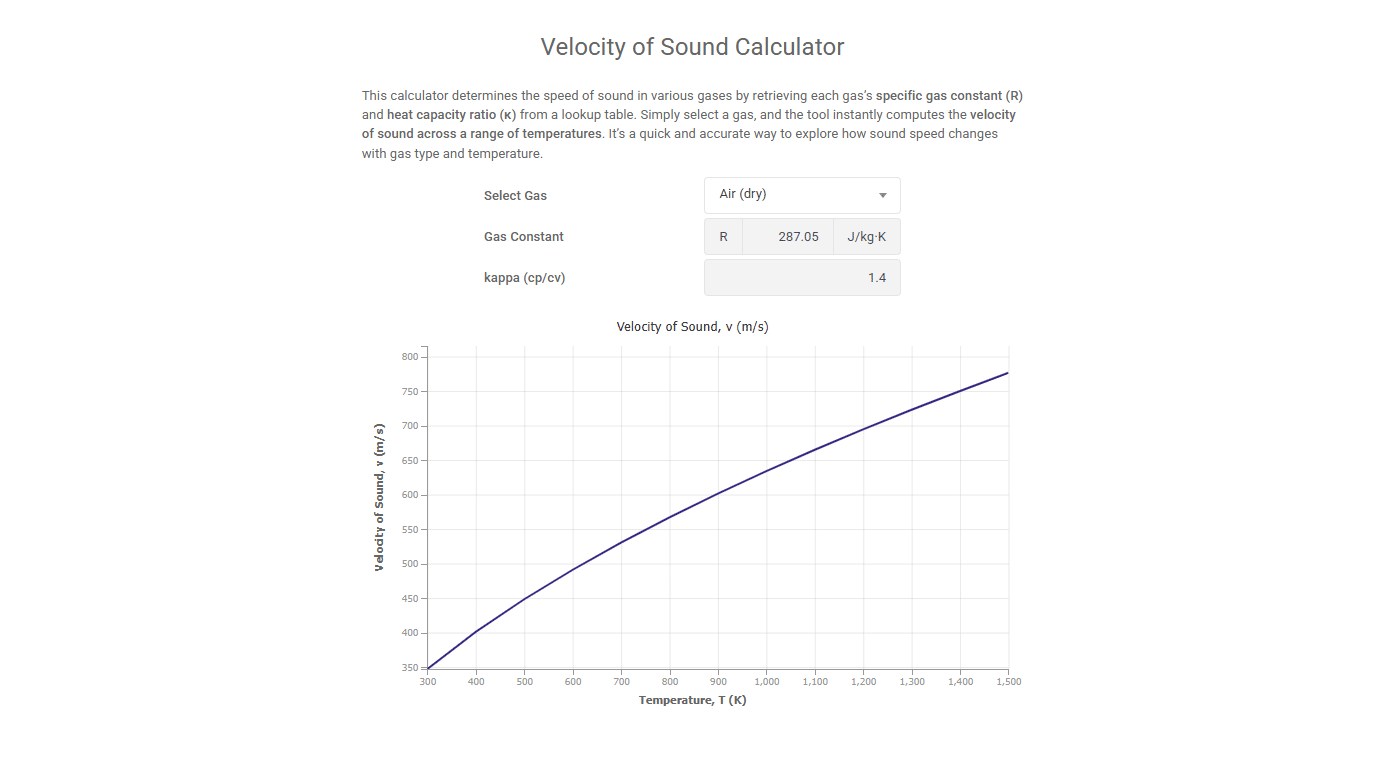
The Velocity of Sound Calculator determines how fast sound travels through different gases based on their thermodynamic properties. The speed of sound depends on the gas constant, specific heat ratio (kappa), and temperature, key parameters in thermodynamics and fluid mechanics. This interactive demo shows how SpreadsheetWeb transforms a detailed Excel-based physics model into a real-time web application.
What Does the Velocity of Sound Calculator Do?
The calculator estimates the speed of sound (a) in different gases as a function of temperature using the standard thermodynamic equation:
a = √(k × R × T)
where k is the adiabatic index (specific heat ratio), R is the gas constant, and T is the absolute temperature in Kelvin.
Users can select a gas from a predefined list, such as air, helium, carbon dioxide, nitrogen, or hydrogen, each with its own thermophysical properties. The calculator then retrieves the correct gas constant (R) and specific heat ratio (kappa) from an internal data table to compute the sound velocity at the desired temperature range.
Key Features
- Instant results: Calculates sound velocity as soon as you select a gas and temperature.
- Accurate thermodynamic data: Uses gas properties based on reference data from engineering sources.
- Excel logic preserved: The original spreadsheet formulas and lookup tables are seamlessly integrated into the web app.
- Real-time visualization: View how sound speed varies with temperature for different gases.
- Mobile friendly: Access and compute from any device, no software installation required.
Scientific Context
The speed of sound is an important parameter in aerodynamics, thermodynamics, and environmental sciences. It determines how acoustic waves travel in air or other gases and varies with temperature and molecular composition. For engineers, this is essential in the design of nozzles, compressors, and acoustic systems, while for researchers it serves as a fundamental physical constant for gas analysis.
Why Convert Excel Models to Web Applications?
- Accessibility: Run scientific models online without sharing spreadsheet files.
- Consistency: Maintain validated equations and data sources in a central platform.
- Visualization: Make calculations more intuitive with interactive user interfaces.
- Scalability: Share with students, researchers, and engineers anywhere.
FAQ
What does the Velocity of Sound Calculator compute?
It calculates the speed of sound in different gases based on their gas constant, adiabatic index (kappa), and temperature.
What gases are included in the calculator?
The calculator includes common gases such as air, nitrogen, helium, carbon dioxide, and hydrogen, each with its corresponding R and kappa values.
What is kappa (cp/cv)?
Kappa, or the adiabatic index, is the ratio of specific heat at constant pressure (cp) to specific heat at constant volume (cv). It defines how compressible a gas is during adiabatic processes.
What are typical applications of this model?
Used in acoustics, thermodynamics, environmental science, and aerospace engineering to predict sound propagation and gas flow behavior.
Can this model be embedded into other web pages?
Yes. SpreadsheetWeb allows you to embed this calculator into your website or share it as a standalone, browser-based application.
Note: This demo was created by converting an Excel-based sound velocity model using SpreadsheetWeb, preserving formulas and data while enabling real-time, web-based computation.