
Engineering demo
Centrifugal Compressor HP
This calculator estimates the horsepower (HP) required for a centrifugal compressor based on suction conditions, discharge pressure, gas properties, and adiabatic efficiency. It first computes the adiabatic head (energy added per unit weight of gas, expressed in feet) and then converts that requirement into compressor power.
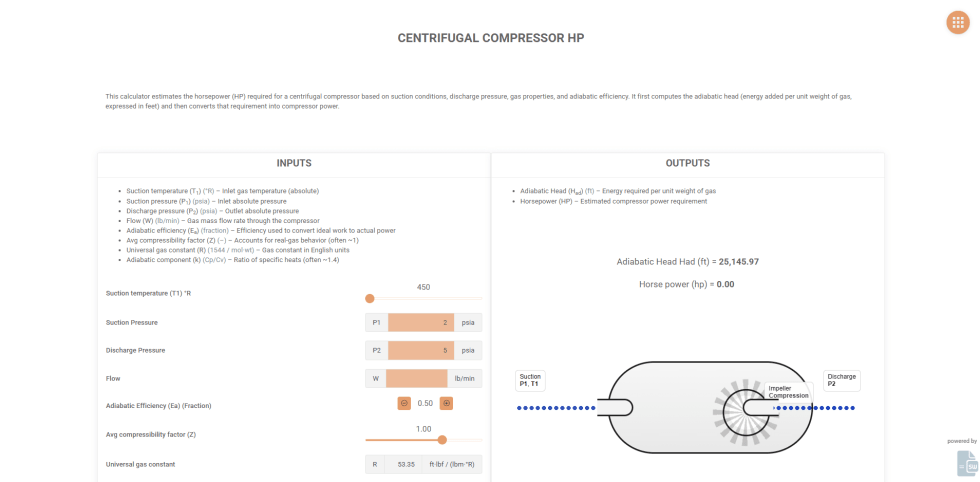
SpreadsheetWeb application example
About this compressor horsepower calculator
Centrifugal Compressor HP demonstrates how an engineering workbook can become a focused browser application without rebuilding its calculation logic. The model combines suction conditions, discharge pressure, mass flow, gas properties, and adiabatic efficiency to estimate the required compressor head and power.
Adjust the operating conditions below to compare scenarios. Every valid change is sent through the website’s secure server-side gateway, calculated by the published SpreadsheetWeb model, and returned as an updated engineering result.
Live engineering model
Estimate compressor head and horsepower
Enter the operating conditions and gas properties. The estimate recalculates automatically from the published spreadsheet model.
The information provided by this calculator is intended for informational and educational purposes only. The default figures shown are hypothetical and may not be applicable to your individual situation. We are not responsible for the consequences of decisions or actions taken in reliance upon the information provided by this tool.
Calculation approach
How the calculation works
- Pressure ratioThe compression severity is set by P2 / P1.
- Adiabatic headTemperature, k, Z, and the pressure ratio determine the ideal head required to reach the discharge pressure.
- HorsepowerMass flow and head are converted into power, then adjusted by adiabatic efficiency to reflect real equipment demand.
Engineering interpretation
Understand what moves the result
- Higher discharge pressure or lower suction pressure increases required head and horsepower.
- Higher inlet temperature generally increases the required work for compression.
- Higher flow increases horsepower nearly proportionally.
- Lower efficiency increases the real power needed for the same ideal head.
- Compressibility factor and k affect how strongly the gas responds to compression.